Construction Energy Costs: Why They Spiral Across Multiple Sites

Updated: Sep 10
For construction businesses, construction energy costs can become difficult to control when projects, meters, suppliers and contracts are spread across multiple sites.
Materials, labour, subcontractors, project timelines, supply chain disruption and client expectations all need to be managed carefully. Energy may not always be the largest cost on a construction project, but when it is spread across multiple sites, suppliers, meters and contracts, it can become difficult to control.
The issue is rarely one single invoice or one contract renewal. More often, construction energy costs become harder to manage because there is no clear view of the full picture.
One site may be on one contract. Another may have temporary supply arrangements. A development may have multiple meters. An office or depot may be managed separately. Different teams may be dealing with different suppliers, while finance teams are left trying to understand whether charges are correct, contracts are aligned, and costs are being properly forecast.
This is where construction energy procurement needs to be more strategic.
Without clear visibility, energy costs can quietly increase across a construction portfolio, affecting budgets, margins and decision-making.
Why construction energy costs are difficult to control
Construction businesses often operate in a way that naturally creates energy complexity.
Unlike a single-site business, construction companies may be managing several live projects at once. Each site can have different requirements, different timelines and different levels of energy use. Some supplies may be temporary. Some may move into permanent arrangements. Some sites may be closing, while others are just starting.
This creates a moving picture, which can be difficult to manage if energy is being dealt with reactively.
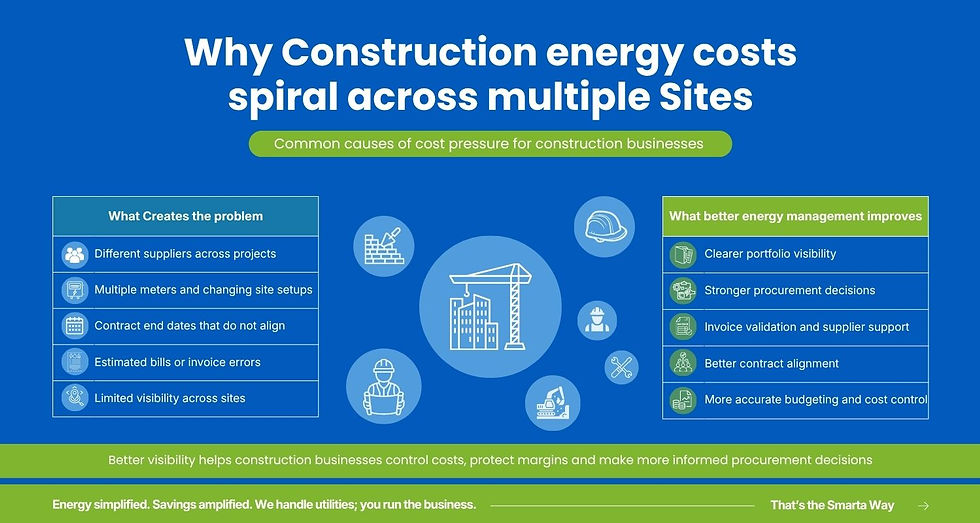
Common challenges include:
multiple sites with different contract end dates
different suppliers across the portfolio
temporary and permanent supplies being managed separately
unclear responsibility between project, commercial, finance and procurement teams
limited visibility of meter details and usage
billing errors or estimated invoices
contracts not aligned with project timelines
supplier queries taking too long to resolve
When this happens, construction energy costs can become harder to forecast and harder to challenge. For Finance Directors, Commercial Directors and Procurement Managers, the problem is not simply that energy prices are high. The bigger issue is often that the business does not have enough visibility or control to know whether it is making the right decisions at the right time.
The risk of treating energy as a last-minute renewal
Many businesses only look at energy when a contract is due for renewal.
For construction businesses, this approach can be risky.
Energy procurement is not just about accepting a new price before a deadline. The timing of the market, the accuracy of usage data, the structure of the contract and the wider needs of the business all matter.
A last-minute renewal can mean decisions are made under pressure, with limited time to review options properly. It can also mean missed opportunities to align contracts across sites, improve reporting or correct issues before they become more expensive.
For a construction business managing multiple sites, procurement should be viewed as part of a wider cost-control strategy.
That means asking questions such as:
Are all sites visible in one place?
Do we know when every contract ends?
Are we buying energy at the right time?
Are our contracts aligned with project timelines?
Are we paying the right rates?
Are invoices being checked properly?
Are we using accurate consumption data?
Are supplier queries being resolved quickly?
Without clear answers, it becomes much harder to reduce construction energy costs or protect project margins.
How poor visibility affects margins
Margins in construction are often carefully managed. Small cost increases across several sites can add up quickly, especially when they are not identified early. Energy costs may be spread across different projects, departments or cost centres, which can make it harder to see the total impact.
Poor visibility can also create problems when forecasting. If finance teams do not have reliable energy data, they may struggle to build accurate budgets. If commercial teams do not understand future costs, project pricing may not fully reflect energy exposure. If procurement teams do not have clear contract information, they may miss opportunities to secure better terms or reduce risk.
This is why multi-site energy management is important. It gives construction businesses a clearer view of where energy is being used, what it is costing and where action may be needed.
Billing errors can increase the problem
Energy billing across construction sites can be complicated. Meters may be installed, removed, exchanged or transferred. Supplies may change status. Sites may open or close. Estimated reads may be used. Supplier data may not always match internal records.
This can lead to incorrect charges, missed credits, duplicate billing or invoices being paid without proper validation.
For a busy finance or accounts team, it is not always practical to manually check every detail across every site. However, without invoice validation, billing errors can go unnoticed.
This means construction businesses may be paying more than they should, without realising it.
A structured approach to invoice validation and supplier management can help identify issues earlier, challenge incorrect charges and improve confidence in the numbers being reported internally.
Why contract alignment matters across multiple sites
Another common issue is contract misalignment. A construction business may have different contracts ending at different times across different sites. Some may have been agreed quickly. Some may sit with different suppliers. Some may no longer reflect the needs of the business.
This can make procurement harder to manage. When contracts are not aligned, businesses may have less control over future purchasing decisions. It can also make reporting, budgeting and supplier management more complicated.
Better construction energy procurement can help bring this together.
That does not always mean moving everything at once. It means reviewing the full portfolio, understanding current commitments and building a procurement approach that supports the way the business actually operates.
For construction companies with multiple live projects, this can make a significant difference to control, planning and internal confidence.
How better energy procurement can help reduce pressure
A more strategic approach to energy procurement can help construction businesses move away from reactive decision-making. This includes reviewing current contracts, understanding consumption data, monitoring the market, validating invoices and creating a clearer plan for renewals, supplier management and future site requirements.
The aim is not just to secure an energy contract. The aim is to give the business better control over energy costs.
This can support:
clearer budgeting
stronger procurement decisions
improved supplier management
reduced billing risk
better contract visibility
more accurate forecasting
improved cost control across sites
greater confidence for finance and commercial teams
For construction businesses, this level of control can help protect margins and reduce unnecessary pressure on internal teams.
When should construction businesses review their energy costs?
Construction businesses should not wait until renewal deadlines to review energy costs.
A review can be useful when:
managing multiple active sites
opening or closing projects
dealing with supplier or billing issues
preparing budgets for the next financial year
reviewing project profitability
experiencing unexpected energy charges
planning new connections or meter changes
looking to improve procurement control
The earlier a business reviews its energy position, the more time it has to make informed decisions. This is especially important in construction, where project timelines, commercial pressures and site requirements can change quickly.
How Smarta Energy supports construction businesses
Smarta Energy works with construction businesses that need clearer control over energy procurement, supplier management, billing and cost visibility. Our support can help bring multiple sites, meters, contracts and suppliers into a more structured process, giving finance, commercial and procurement teams a clearer view of their energy position.
We can support with:
construction energy procurement
contract review and renewal planning
multi-site energy management
supplier coordination
invoice validation
billing query support
energy reporting and data visibility
cost control and budget planning
For construction businesses dealing with complex portfolios, this can help reduce uncertainty, improve internal visibility and support more confident decision-making.
Reduce construction energy costs with better control
Construction energy costs often spiral because the full picture is not visible. When sites, meters, suppliers and contracts are managed separately, it becomes harder to know whether the business is buying well, paying correctly or planning effectively.
A more structured approach to construction energy procurement can help reduce that pressure. By improving visibility, reviewing contracts, validating invoices and managing suppliers more effectively, construction businesses can take greater control of energy costs across multiple sites.
Looking to reduce construction energy costs across your sites? Smarta Energy can help review your current position and identify where better procurement, supplier management and cost visibility could support your business.
Frequently asked questions
Why do construction energy costs become difficult to control?
Construction energy costs become difficult to control when businesses are managing multiple sites, suppliers, meters and contracts without a clear central view. This can lead to billing issues, poor contract visibility and weaker cost forecasting.
How can construction businesses reduce energy costs?
Construction businesses can reduce energy costs by reviewing procurement strategy, checking contract terms, validating invoices, improving data visibility and managing supplier relationships more effectively.
Why is energy procurement important for construction businesses?
Energy procurement is important because construction businesses often deal with changing site requirements, multiple contracts and complex utility arrangements. A structured procurement approach can help improve cost control and protect margins.
What causes energy billing issues on construction sites?
Billing issues can be caused by estimated meter reads, incorrect rates, meter changes, supplier errors, duplicate charges, unclear site information or poor data management.
When should a construction business review its energy contracts?
A construction business should review its energy contracts before renewal deadlines, when opening or closing sites, when costs increase unexpectedly, or when preparing budgets for future projects.


Comments